


Credit Card Fraud Detection Platform Market Summary
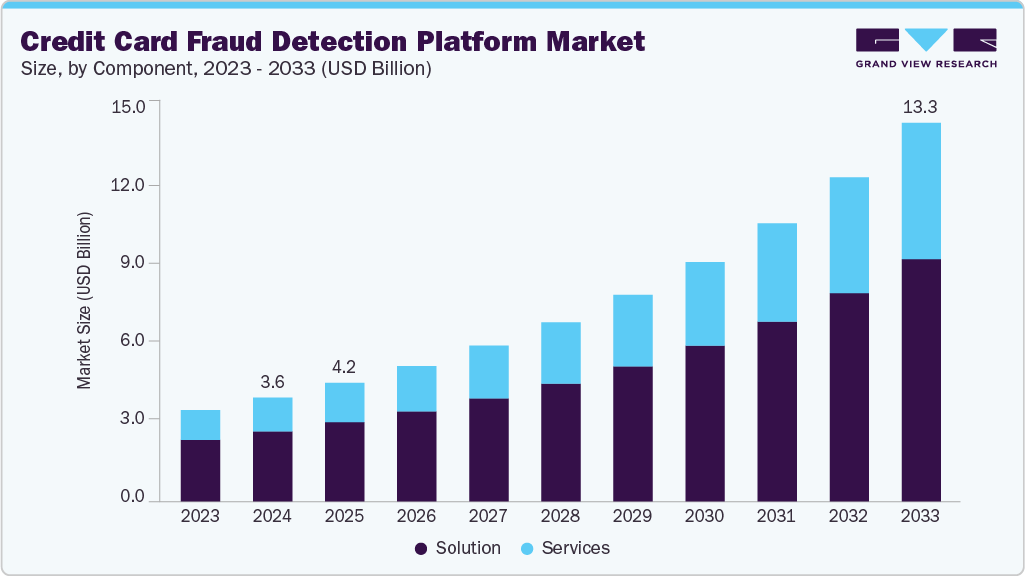
The global credit card fraud detection platform market size was estimated at USD 3.64 billion in 2024, and is projected to reach USD 13.29 billion by 2033, growing at a CAGR of 15.6% from 2025 to 2033. This significant growth is primarily driven by the rising volume of digital transactions, increased adoption of e-commerce, and the growing innovation of cyber threats targeting financial institutions and consumers alike.
Key Market Trends & Insights
- The North America credit card fraud detection platform market accounted for a 38.2% share of the overall market in 2024.
- The credit card fraud detection platform industry in the U.S. held a dominant position in 2024.
- By component, the solution segment accounted for the largest share of 67.2% in 2024.
- By deployment, the cloud segment held the largest market share in 2024.
- By technology, the artificial intelligence (AI)/machine learning segment dominated the market in 2024.
Market Size & Forecast
- 2024 Market Size: USD 3.64 Billion
- 2033 Projected Market Size: USD 13.29 Billion
- CAGR (2025-2033): 15.6%
- North America: Largest market in 2024
- Asia Pacific: Fastest growing market
The growing integration of artificial intelligence (AI) and machine learning (ML) technologies is significantly propelling the market growth of credit card fraud detection platforms. Public financial bodies have increasingly acknowledged that AI-driven models are capable of processing complex transactional behavior in real time, allowing systems to flag anomalies with higher precision and lower false-positive rates. These intelligent systems leverage advanced pattern recognition, ensemble learning, and neural network frameworks that continuously evolve through adaptive learning. The adoption of such technology across governmental financial systems underscores its effectiveness in accelerating fraud identification and prevention efforts, especially in dynamic digital transaction environments. As AI and ML continue to mature, they are transforming credit card fraud detection from a reactive process to a proactive defense mechanism, reinforcing platform resilience and boosting the market’s technological advancement.

The rise of real-time payment infrastructures across financial ecosystems is boosting the market for fraud detection platforms built with instantaneous transaction monitoring capabilities. With real-time payments becoming mainstream, the need for fraud detection systems that can analyze and respond within milliseconds has become a critical requirement. Government-backed payment systems have emphasized the importance of integrating fraud protection directly into the payment rails to maintain user trust and security. These platforms employ behavioral biometrics, contextual analysis, and device intelligence to evaluate transaction legitimacy at the point of initiation. This capability not only reduces fraud losses but also enhances customer experience by minimizing unnecessary transaction blocks. As real-time settlement becomes an industry norm, the adoption of rapid fraud detection technology is acting as a major catalyst for market expansion.
The tightening of global regulatory frameworks is fueling the development of more advanced fraud detection platforms that align with new compliance standards. National financial regulators have issued updated guidelines emphasizing the use of technology, including AI and automated analytics, to detect illicit activity and ensure robust reporting mechanisms. These directives encourage institutions to modernize outdated systems and adopt dynamic fraud detection tools capable of identifying suspicious behavior across domestic and cross-border financial networks. Additionally, oversight bodies have called for improved governance around the use of AI in detection systems, focusing on transparency, risk controls, and model validation. These compliance-driven imperatives are encouraging broader deployment of intelligent fraud platforms, effectively stimulating innovation and pushing the market toward more secure and agile solutions.
The integration of biometric authentication into payment systems is driving market momentum by delivering enhanced security and streamlined user experiences. Government agencies and financial institutions have increasingly turned to biometric solutions such as facial recognition, fingerprint scanning, and iris detection to strengthen identity verification processes. These methods offer a more secure alternative to traditional passwords and PINs, which are frequently compromised. Moreover, biometric data is far more difficult for cybercriminals to replicate, making it an effective barrier against unauthorized access and account takeovers. As contactless transactions and mobile banking gain popularity, the demand for seamless yet secure authentication continues to rise. The ability to embed biometric verification into fraud detection workflows is enhancing platform credibility and supporting broader digital transformation initiatives, thereby propelling growth across the credit card fraud detection platform industry landscape.
The emerging challenge posed by quantum computing is prompting financial institutions and technology providers to reassess the cryptographic foundations of fraud detection platforms, strengthening the long-term stability of the market. Government agencies responsible for cybersecurity have already endorsed the transition toward post-quantum cryptographic algorithms to safeguard financial data against future decryption threats. In response, leading financial institutions are proactively piloting quantum-secure solutions and integrating crypto-agility into their platform designs. This shift ensures that fraud detection systems will remain resilient as quantum capabilities advance, avoiding vulnerabilities associated with traditional encryption standards. These efforts are not only enhancing confidence in digital payment systems but also positioning quantum-resistant fraud detection as a forward-looking investment, reinforcing trust, and laying the groundwork for sustainable market growth.
Component Insights
The solution segment led the credit card fraud detection platform market with the largest share of 67.2% in 2024. The solution segment is witnessing strong momentum, driven by the urgent demand for integrated fraud detection systems that combine data visualization, real-time analytics, and intelligent risk scoring. As cyber threats grow more advanced, end users are prioritizing comprehensive platforms that offer adaptive learning models, rule engines, and anomaly detection in a single interface. This bundled approach reduces the need for multiple vendors and improves response times, boosting the adoption of standalone fraud detection solutions across banking, telecom, and fintech ecosystems.
The services segment is expected to grow at the fastest CAGR during the forecast period. The services segment is playing a pivotal role in ensuring the long-term effectiveness and customization of fraud detection platforms. Consulting, integration, and support services are gaining traction as enterprises look for expert guidance in deploying complex systems, aligning with compliance mandates, and training AI models on organization-specific datasets. Managed service providers, in particular, are being leveraged to handle ongoing platform monitoring, allowing institutions to focus on core operations, thus fueling steady growth in this segment.
Deployment Insights
The cloud segment held the largest share of the credit card fraud detection platform industry in 2024 and is expected to grow at the fastest CAGR during the forecast period. The cloud segment is rapidly becoming the deployment model of choice, due to its flexibility, cost efficiency, and ease of integration with AI-powered analytics. Startups and modern financial service providers are gravitating toward cloud-native fraud detection tools that can be quickly deployed and scaled on demand. Cloud architecture also enables faster updates, automated threat intelligence sharing, and broader interoperability, features that are crucial in combating ever-evolving fraud vectors. This shift is significantly boosting market growth in both developed and emerging digital economies.
The on-premise segment is expected to grow at a significant CAGR during the forecast period. The on-premise deployment model continues to attract institutions in regions with stringent data residency laws and security regulations. Highly sensitive sectors such as banking and government still rely on in-house infrastructure to maintain greater control over data access and system performance. In cases where legacy IT investments remain substantial, the preference for on-premise deployment persists, particularly in geographies where compliance with local cybersecurity regulations is non-negotiable. This entrenched demand is helping sustain growth despite the rise of cloud-native solutions.
Technology Insights
The Artificial Intelligence (AI)/machine learning segment dominated the credit card fraud detection platform market in 2024 and is expected to grow at the fastest CAGR during the forecasted period. AI and machine learning are redefining the technological backbone of fraud detection platforms. These tools allow systems to recognize subtle behavioral patterns, detect outliers, and evolve their detection logic continuously without manual rule configuration. Institutions are leveraging AI/ML to reduce false positives, automate workflows, and proactively adapt to novel attack methods, thus enhancing operational efficiency and fraud prevention effectiveness. This paradigm shift toward intelligent decision-making is rapidly pushing the AI/ML segment to the forefront of the market.
The predictive analytics segment is projected to grow at a significant CAGR over the forecast period. Predictive analytics is emerging as a strategic tool for early fraud risk identification. By analyzing historical data, customer spending habits, and external threat indicators, predictive models allow organizations to intervene before suspicious activities escalate into actual fraud. These systems are particularly useful in subscription-based payment models and recurring transactions, where pattern recognition helps flag anomalies proactively. As enterprises focus on preemptive strategies, the role of predictive analytics in fraud prevention is gaining broader acceptance, fueling demand in data-driven environments.
Application Insights
The transaction monitoring segment dominated the credit card fraud detection platform market in 2024 and is projected to grow at the fastest CAGR over the forecast period. With rising volumes of digital transactions across credit cards, mobile wallets, and contactless payments, organizations are increasingly prioritizing real-time monitoring to flag suspicious behaviors at the point of sale or transfer. Transaction monitoring systems are evolving to offer contextual analysis, considering device, location, time, and user behavior simultaneously, making them a critical first line of defense. This strategic importance is propelling the segment’s growth as payment ecosystems become more complex.
The account takeover detection segment is projected to grow at a significant CAGR over the forecast period. The account takeover detection segment is gaining prominence as cybercriminals shift focus toward exploiting compromised user credentials. Advanced bots, credential stuffing attacks, and phishing scams have made account takeovers a major threat to financial integrity. Fraud detection platforms are now integrating biometric verification, session fingerprinting, and behavioral biometrics to detect anomalies in user access patterns. As digital identity threats rise, the demand for robust account takeover protection continues to grow, reinforcing the segment’s relevance across industries.
End Use Insights
The BFSI segment dominated the credit card fraud detection platform industry in 2024 and is projected to grow at a significant CAGR over the forecast period. This growth is driven by the sector’s inherent risk exposure and regulatory obligations. With the increased adoption of digital banking, mobile wallets, and credit card-based lending, BFSI institutions face growing pressure to safeguard client data and transaction integrity. Advanced fraud detection platforms are being employed to ensure compliance with anti-money laundering (AML) rules, payment security mandates, and customer trust expectations, making this segment the backbone of market demand.
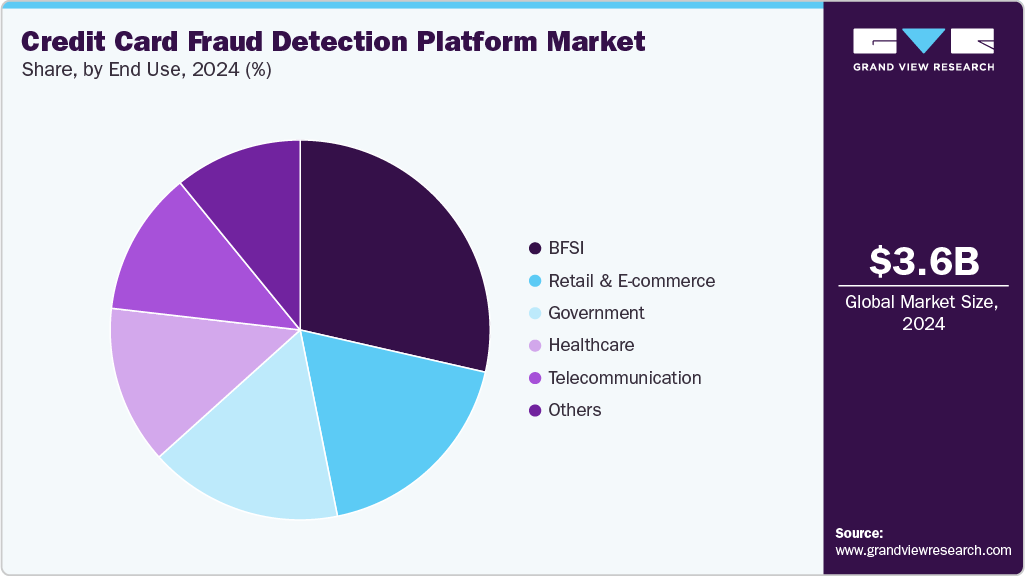
The telecommunication segment is projected to grow at the fastest CAGR over the forecast period. The telecommunication sector is witnessing rapid adoption of fraud detection technologies, particularly as telecom operators expand into mobile payments, digital wallets, and subscriber billing platforms. Fraud types such as SIM swap, subscription fraud, and fake account creation have become increasingly common in telecom ecosystems. As a result, operators are integrating credit card fraud detection engines into customer onboarding and transaction workflows. This expansion into financial-like services is positioning telecom companies as critical contributors to market growth.
Regional Insights
The North America credit card fraud detection platform market accounted for the largest market share of 38.2% in 2024. North America continues to lead in the adoption of credit card fraud detection platforms due to its mature financial infrastructure and heightened awareness around cybersecurity. Financial institutions across the region are heavily investing in advanced fraud prevention mechanisms as digital payment channels expand. The region is witnessing increasing integration of behavioral biometrics and real-time fraud detection systems into banking platforms. This proactive approach by regional banks and fintech players is significantly boosting the market.

U.S. Credit Card Fraud Detection Platform Market Trends
The U.S. credit card fraud detection platform industry held a dominant position in 2024, driven by a rapidly growing e-commerce sector and a high rate of credit card penetration. Regulatory frameworks such as the Gramm-Leach-Bliley Act and initiatives from the Federal Trade Commission have pushed institutions to adopt more robust fraud detection measures. Additionally, collaborations between the public and private sectors, including the support of federal agencies to mitigate financial cybercrime, are propelling the market growth for intelligent fraud detection platforms in the country.
Europe Credit Card Fraud Detection Platform Market Trends
The Europe credit card fraud detection platform industry was identified as a lucrative region in 2024. Europe is seeing a significant push toward real-time fraud detection systems in response to increasing incidents of cross-border online fraud. The region’s commitment to consumer data privacy through legislation such as GDPR has led to a demand for fraud detection solutions that are both secure and compliant. Financial entities are integrating fraud analytics with their compliance systems, particularly in the wake of growing pressure from regulators to reduce false positives and increase operational efficiency.
The Germany credit card fraud detection platform market is expected to grow over the forecast period. Germany is emerging as a key adopter of AI-driven fraud prevention tools, especially within its highly digitalized banking sector. With German consumers increasingly using digital wallets and contactless payment options, there’s a rising demand for systems that can track and flag anomalies in transaction behavior. German banks and fintech startups are experimenting with graph analytics and machine learning models to safeguard user data and reduce fraud incidents in real time, fostering market growth.
The credit card fraud detection platform market in the UK is anticipated to grow during the forecast period. The UK’s aggressive stance against payment fraud has led to notable growth in the deployment of fraud detection platforms across both legacy banks and neobanks. The Financial Conduct Authority’s guidelines on operational resilience have further strengthened investment in fraud mitigation technologies. The rise of open banking in the UK is also contributing to this trend, as APIs increase the risk of data breaches, prompting banks to reinforce their fraud prevention ecosystems.
Asia Pacific Credit Card Fraud Detection Platform Market Trends
The Asia Pacific credit card fraud detection platform industry is expected to grow at the fastest CAGR during the forecast period. The APAC region is witnessing a swift transformation in its digital economy, with rising mobile payments, online banking, and cross-border e-commerce. This has led to a surge in fraud cases, pushing banks and fintech companies to invest in predictive and adaptive fraud detection systems. Countries in the region are adopting cloud-based fraud prevention solutions that offer scalability, speed, and integration with digital platforms, thereby driving the regional market forward.
The China credit card fraud detection platform market is projected to grow during the forecast period. China’s vast digital payment ecosystem, dominated by platforms like Alipay and WeChat Pay, has created fertile ground for fraud detection innovation. Government-backed initiatives supporting fintech security and efforts to clamp down on online scams have encouraged the adoption of advanced anti-fraud platforms. Domestic financial institutions are integrating AI with real-time behavioral analytics to curb fake transaction attempts, reinforcing the country’s role in the global fraud detection landscape.
The credit card fraud detection platform market in India is anticipated to grow in the forthcoming years. India’s rapid fintech expansion, driven by initiatives like UPI and Aadhaar-based banking, has elevated the need for robust credit card fraud detection. With cybercrime on the rise, Indian banks are actively partnering with technology providers to deploy machine learning-powered fraud analytics. The Reserve Bank of India’s guidelines for secure digital transactions have also played a pivotal role in encouraging financial entities to adopt next-gen fraud prevention solutions across all touchpoints.
Key Credit Card Fraud Detection Platform Company Insights
Some of the major players in the credit card fraud detection platform market include FICO, SAS Institute Inc., NICE Actimize, ACI Worldwide, Experian Information Solutions, Inc., and Feedzai, due to their robust analytics capabilities, advanced AI-driven fraud detection models, global presence, and strong partnerships with leading financial institutions that help them offer scalable and real-time fraud prevention solutions.
-
FICO is a leading analytics software company best known for pioneering the FICO Score, a standard measure of consumer credit risk in the U.S. financial system. Over the decades, FICO has evolved into a prominent provider of decision management solutions, offering software and tools that help businesses optimize risk assessment, fraud detection, and credit scoring. The company’s platform leverages machine learning, predictive analytics, and artificial intelligence to deliver real-time insights across industries, particularly in banking, insurance, and retail. FICO’s fraud detection solutions are used globally to secure card payments, reduce false positives, and prevent losses from fraudulent transactions.
-
Feedzai is a global data science company specializing in risk management and fraud prevention. It offers an advanced AI-powered risk operations platform used by financial institutions and merchants to detect, prevent, and respond to financial fraud in real-time. Feedzai’s technology is built to analyze large volumes of transactional data, utilizing machine learning models to identify anomalies and suspicious patterns. The company focuses on enhancing payment security, ensuring regulatory compliance, and improving customer trust across digital banking ecosystems. Its platform supports a wide range of applications, including credit card fraud detection, account takeover prevention, and anti-money laundering (AML) measures.
Key Credit Card Fraud Detection Platform Companies:
The following are the leading companies in the credit card fraud detection platform market. These companies collectively hold the largest market share and dictate industry trends.
- FICO
- SAS Institute Inc.
- NICE Actimize
- ACI Worldwide
- Experian Information Solutions, Inc.
- Feedzai
- Featurespace Limited
- Equifax Inc.
- RSA Security USA LLC
- LexisNexis Risk Solutions
Recent Developments
-
On July 10, 2025, FICO was recognized with the Credit Award for Excellence in Fraud Prevention for its deployment at Barclays. The system utilized FICO’s latest “Scam Signal” technology to detect social‑engineering schemes during onboarding and prevented multiple fraudulent attempts on its first day.
-
On February 18, 2025, Feedzai partnered with Mastercard to scale its Consumer Fraud Risk (CFR) platform globally. Launching initially in the UK in 2023, the CFR solution helped reduce authorized push-payment scams by over 12%, as reported by the UK Payment Systems Regulator.
Credit Card Fraud Detection Platform Market Report Scope
|
Report Attribute
|
Details
|
|
Market size value in 2025
|
USD 4.16 billion
|
|
Revenue forecast in 2033
|
USD 13.29 billion
|
|
Growth rate
|
CAGR of 15.6% from 2025 to 2033
|
|
Base year for estimation
|
2024
|
|
Historical data
|
2021 – 2023
|
|
Forecast period
|
2025 – 2033
|
|
Quantitative units
|
Revenue in USD million/billion and CAGR from 2025 to 2033
|
|
Report coverage
|
Revenue forecast, company ranking, competitive landscape, growth factors, and trends
|
|
Segments covered
|
Component, deployment, technology, application, end use, and region
|
|
Regional scope
|
North America; Europe; Asia Pacific; Latin America; MEA
|
|
Country scope
|
U.S.; Canada; Mexico; Germany; UK; France; China; Japan; India; South Korea; Australia; Brazil; KSA; UAE; South Africa
|
|
Key companies profiled
|
FICO; SAS Institute Inc.; NICE Actimize; ACI Worldwide; Experian Information Solutions, Inc.; Feedzai; Featurespace Limited; Equifax Inc.; RSA Security USA LLC; LexisNexis Risk Solutions
|
|
Customization scope
|
Free report customization (equivalent up to 8 analysts working days) with purchase. Addition or alteration to country, regional & segment scope.
|
|
Pricing and purchase options
|
Avail customized purchase options to meet your exact research needs. Explore purchase options
|
Global Credit Card Fraud Detection Platform Market Report Segmentation
This report forecasts revenue growth at the global, regional, and country levels and provides an analysis of the latest industry trends in each of the sub-segments from 2021 to 2033. For this study, Grand View Research has segmented the Global credit card fraud detection platform market report based on component, deployment, technology, application,end use, and region:
-
Component Outlook (Revenue, USD Million, 2021 – 2033)
-
Deployment Outlook (Revenue, USD Million, 2021 – 2033)
-
Technology Outlook (Revenue, USD Million, 2021 – 2033)
-
Application Outlook (Revenue, USD Million, 2021 – 2033)
-
End Use Outlook (Revenue, USD Million, 2021 – 2033)
-
BFSI
-
Retail & E-commerce
-
Government
-
Healthcare
-
Telecommunication
-
Others
-
-
Regional Outlook (Revenue, USD Million, 2021 – 2033)
Frequently Asked Questions About This Report
b. The global credit card fraud detection platform market size was estimated at USD 3.64 billion in 2024 and is expected to reach USD 4.16 billion in 2025.
b. The global credit card fraud detection platform market size is expected to grow at a significant CAGR of 15.6% to reach USD 13.29 billion in 2033.
b. North America held the largest market share of 38.2% in 2024. North America continues to lead in the adoption of credit card fraud detection platforms due to its mature financial infrastructure and heightened awareness around cybersecurity.
b. Some of the players in the credit card fraud detection platform market are FICO, SAS Institute Inc., NICE Actimize, ACI Worldwide, Experian Information Solutions, Inc., Feedzai, Featurespace Limited, Equifax Inc., RSA Security USA LLC, and LexisNexis Risk Solutions.
b. The key driving trend in the credit card fraud detection platform market is the growing adoption of AI, machine learning, and advanced analytics to enable real-time fraud detection and prevention. As fraudulent transactions become more sophisticated with tactics like account takeovers, identity theft, and synthetic fraud, financial institutions and payment providers are increasingly shifting from traditional rule-based systems to adaptive, predictive models that analyze large volumes of transaction data instantly. This trend is further supported by the rise of digital payments, e-commerce growth, and regulatory pressure to ensure stronger security, pushing organizations to invest in platforms that enhance accuracy, reduce false positives, and deliver faster response times.
link