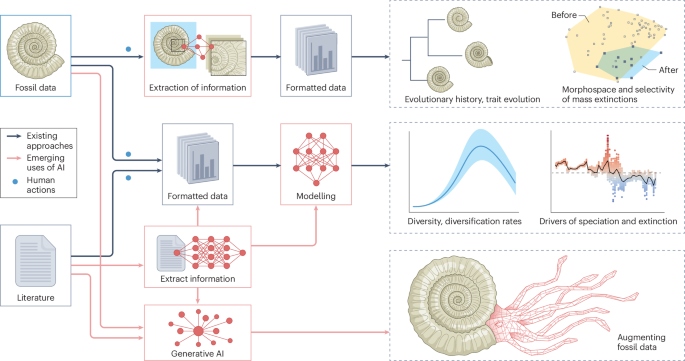
Emerging uses of artificial intelligence in deep time biodiversity research
Raup, D. M. & Sepkoski, J. J. Mass extinctions in the marine fossil record. N. Ser. 215, 1501–1503 (1982).
Google Scholar
Benton, M. J. Recovery of vertebrate faunas from the end-Permian mass extinction. J. Earth Sci. 21 111 (2010).
Benton, M. J. Origins of biodiversity. PLoS Biol. (2016).
Marshall, C. R. Forty years later: the status of the ‘Big Five’ mass extinctions. Camb. Prism Extinct. 1, e5 (2023).
Casanovas-Vilar, I., van den Hoek Ostende, L. W., Janis, C. M. & Saarinen, J. eds. Evolution of Cenozoic Land Mammal Faunas and Ecosystems 25 Years of the NOW Database of Fossil Mammals Vertebrate Paleobiology and Paleoanthropology Series (Springer, 2023).
Uhen, M. D. et al. Paleobiology Database User Guide Version 1.0. PaleoBios 40(11) (2023).
Peters, S. E. & McClennen, M. The Paleobiology Database Application Programming Interface. Paleobiology 42, 1–7 (2015).
Chiappe, L. M. et al. Cretaceous bird from Brazil informs the evolution of the avian skull and brain. Nature 635, 376–381 (2024).
Google Scholar
Niklas, K. J., Tiffany, B. H. & Knoll, A. H. Patterns in vascular land plant diversification. Nature 303, 1068–1070 (1983).
Niklas, K. J. Measuring the tempo of plant death and birth. N. Phytol. 207, 254–256 (2015).
Sepkoski, J. J. A factor analytic description of the Phanerozoic marine fossil record. Paleobiology 7 36–53 (1981).
Dunne, E. M., Thompson, S. E. D., Butler, R. J., Rosindell, J. & Close, R. A. Mechanistic neutral models show that sampling biases drive the apparent explosion of early tetrapod diversity. Nat. Ecol. Evol. 7, 1480–1489 (2023).
Close, R. A., Benson, R. B. J., Saupe, E. E., Clapham, M. E. & Butler, R. J. The spatial structure of Phanerozoic marine animal diversity. Science 368, 420–424 (2020).
Google Scholar
Reijenga, B. R. & Close, R. A. Apparent timescaling of fossil diversification rates is caused by sampling bias. Curr. Biol. (2025).
Marshall, C. R. et al. Quantifying the dark data in museum fossil collections as palaeontology undergoes a second digital revolution. Biol. Lett. 14, 20180431 (2018).
Adaimé, M.-É., Urban, M. A., Kong, S., Jaramillo, C. & Punyasena, S. W. Pollen morphology, deep learning, phylogenetics, and the evolution of environmental adaptations in Podocarpus. New Phytol. 247, 1460–1473 (2025).
Jumper, J. et al. Highly accurate protein structure prediction with AlphaFold. Nature 596, 583–589 (2021).
Google Scholar
Tropsha, A., Isayev, O., Varnek, A., Schneider, G. & Cherkasov, A. Integrating QSAR modelling and deep learning in drug discovery: the emergence of deep QSAR. Nat. Rev. Drug Discov. 23, 141–155 (2023).
Müller, J. et al. Soundscapes and deep learning enable tracking biodiversity recovery in tropical forests. Nat. Commun. 14, 6191 (2023).
Romera-Paredes, B. et al. Mathematical discoveries from program search with large language models. Nature 625, 468–475 (2023).
Thompson, T. How AI can help to save endangered species. Nature 623, 232–233 (2023).
Google Scholar
Silvestro, D., Goria, S., Sterner, T. & Antonelli, A. Improving biodiversity protection through artificial intelligence. Nat. Sustain. 5, 415–424 (2022).
Christin, S., Hervet, É. & Lecomte, N. Applications for deep learning in ecology. Methods Ecol. Evol. 10, 1632–1644 (2019).
Yu, C. et al. Artificial intelligence in paleontology. Earth Sci. Rev. 252, 104765 (2024).
He, Y. et al. Opportunities and challenges in applying AI to evolutionary morphology. Integr. Org. Biol. 6, 36 (2024).
Mimura, K. et al. Applicability of object detection to microfossil research: implications from deep learning models to detect microfossil fish teeth and denticles using YOLO-v7. Earth Space Sci. 11, e2023EA003122 (2024).
van de Kamp, T. et al. Parasitoid biology preserved in mineralized fossils. Nat. Commun. 9, 3325 (2018).
Romero, I. C. et al. Improving the taxonomy of fossil pollen using convolutional neural networks and superresolution microscopy. Proc. Natl Acad. Sci. USA 117, 28496–28505 (2020).
Google Scholar
Kopperud, B. T., Lidgard, S. & Liow, L. H. Enhancing georeferenced biodiversity inventories: automated information extraction from literature records reveal the gaps. PeerJ 10, e13921 (2022).
Di Martino, E. et al. DeepBryo: a web app for AI-assisted morphometric characterization of cheilostome bryozoans. Limnol. Oceanogr. Methods 21, 542–551 (2023).
Liu, X. et al. Heterogeneous selectivity and morphological evolution of marine clades during the Permian–Triassic mass extinction. Nat. Ecol. Evol. 8, 1248–1258 (2024).
Weeks, B. C. et al. A deep neural network for high-throughput measurement of functional traits on museum skeletal specimens. Methods Ecol. Evol. 14, 347–359 (2023).
Hou, C. et al. Fossil image identification using deep learning ensembles of data augmented multiviews. Methods Ecol. Evol. 14, 3020–3034 (2023).
Foster, W. J. et al. How predictable are mass extinction events? R. Soc. Open Sci. 10, 221507 (2023).
Foster, W. J. et al. Machine learning identifies ecological selectivity patterns across the end-Permian mass extinction. Paleobiology 48, 357–371 (2022).
Finnegan, S. et al. Paleontological baselines for evaluating extinction risk in the modern oceans. Science 348, 567–570 (2015).
Google Scholar
Cooper, R. B., Flannery-Sutherland, J. T. & Silvestro, D. DeepDive: estimating global biodiversity patterns through time using deep learning. Nat. Commun. 15, 4199 (2024).
Google Scholar
Nickolls, J. & Dally, W. J. The GPU computing era. IEEE Micro (2010).
Vaswani, A. et al.Attention is all you need. In Advances in Neural Information Processing Systems 30 (eds. Guyon, I. et al.) (2017).
Koch, B., Denton, E., Hanna, A. & Foster, J. G. Reduced, reused and recycled: the life of a dataset in machine learning research. Preprint at (2021).
Villalobos, P. et al. Will we run out of data? Limits of LLM scaling based on human-generated data. Preprint at (2024).
Sayers, E. W. et al. GenBank 2025 update. Nucleic Acids Res. 53, D56–D61 (2025).
Waller, J. Citizen Science on GBIF – 2019. GBIF Data Blog (2019).
Heberling, J. M., Miller, J. T., Noesgaard, D., Weingart, S. B. & Schigel, D. Data integration enables global biodiversity synthesis. Proc. Natl Acad. Sci. USA 118, e2018093118 (2021).
Google Scholar
Renaudie, J., Lazarus, D. B. & Diver, P. Nsb (Neptune Sandbox Berlin): an expanded and improved database of marine planktonic microfossil data and deep-sea stratigraphy. Palaeontol. Electron. 23, 1–28 (2020).
Žliobaitė, I. et al. The NOW database of fossil mammals. Vertebr. Paleobiol. Paleoanthropol. F1250, 33–42 (2023) .
Kocsis, Á. T., Reddin, C. J., Alroy, J. & Kiessling, W. The R package divDyn for quantifying diversity dynamics using fossil sampling data. Methods Ecol. Evol. 10, 735–743 (2019).
Smith, J. et al. BioDeepTime: a database of biodiversity time series for modern and fossil assemblages. Glob. Ecol. Biogeogr. 32, 1680–1689 (2023).
Smith, J. A. et al. Increasing the equitability of data citation in paleontology: capacity building for the big data future. Paleobiology 50, 165–176 (2024).
Nicol, D. The number of living animal species likely to be fossilized. Fla. Scientist 40, 135–139 (1977).
Foote, M., Miller, A. I., Raup, D. M. & Stanley, S. M. Principles of Paleontology (Macmillan, 2007).
Andermann, T., Antonelli, A., Barrett, R. L. & Silvestro, D. Estimating alpha, beta, and gamma diversity through deep learning. Front. Plant Sci. 13, 839407 (2022).
Zhuang, F. et al. A comprehensive survey on transfer learning. Proc. IEEE 109, 43–76 (2021).
Kim, H. E. et al. Transfer learning for medical image classification: a literature review. BMC Med. Imaging 22, 69 (2022).
Theodoris, C. V. et al. Transfer learning enables predictions in network biology. Nature 618, 616–624 (2023).
Google Scholar
Hauffe, T., Cantalapiedra, J. L. & Silvestro, D. Trait-mediated speciation and human-driven extinctions in proboscideans revealed by unsupervised Bayesian neural networks. Sci. Adv. 10, eadl2643 (2024).
Marjoram, P., Molitor, J., Plagnol, V. & Tavaré, S. Markov chain Monte Carlo without likelihoods. Proc. Natl Acad. Sci. USA 100, 15324–15328 (2003).
Google Scholar
Silvestro, D. et al. A 450 million years long latitudinal gradient in age-dependent extinction. Ecol. Lett. 23, 439–446 (2020).
Lambert, S., Voznica, J. & Morlon, H. Deep learning from phylogenies for diversification analyses. Syst. Biol. 72, 1262–1279 (2023).
Close, R. A. et al. Diversity dynamics of Phanerozoic terrestrial tetrapods at the local-community scale. Nat. Ecol. Evol. 3, 590–597 (2019).
Ahmad, W., Ali, H., Shah, Z. & Azmat, S. A new generative adversarial network for medical images super resolution. Sci. Rep. 12, 1–20 (2022).
Nie, D. et al. Medical image synthesis with deep convolutional adversarial networks. IEEE Trans. Biomed. Eng. 65, 2720–2730 (2018).
Khosravi, B. et al. Few-shot biomedical image segmentation using diffusion models: beyond image generation. Comput. Methods Prog. Biomed. 242, 107832 (2023).
Huang, Y. et al. SmartEdit: exploring complex instruction-based image editing with multimodal large language models. In 2024 IEEE/CVF Conference on Computer Vision and Pattern Recognition (CVPR), (IEEE, 2023).
Rawte, V., Sheth, A. & Das, A. A survey of hallucination in large foundation models. Preprint at (2023).
Zhang, Y. et al. Siren’s song in the AI ocean: a survey on hallucination in large language models. Comput. Linguist. (2025).
Bai, Y. et al. Training a helpful and harmless assistant with reinforcement learning from human feedback. Preprint at (2022).
Bagenal, J. Generative artificial intelligence and scientific publishing: urgent questions, difficult answers. Lancet 403, 1118–1120 (2024).
link