‘Big White Fog’ opens Court Theatre season | Arts & Entertainment
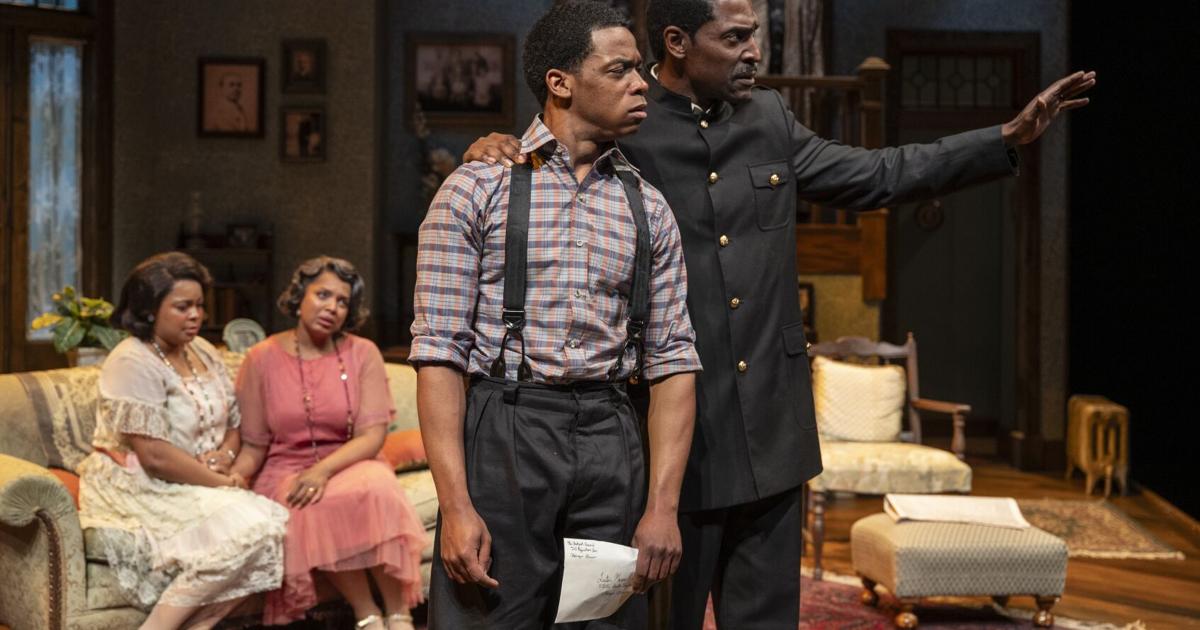
Hats off to Court Theatre for opening its season with “Big White Fog,” Theodore Ward’s dense 1938 drama about a multi-generational Black family living on Chicago’s South Side, as well as to director Ron OJ Parson for bringing it vividly to life and to the cast of 17 actors, each giving a memorable performance.
Set not far from where the theater is now, there’s also a certain irony associated with a contemporary production of Ward’s first full-length play. It was originally produced by the Negro Unit of the Federal Theatre Project in Chicago, a WPA New Deal program designed primarily to fund jobs for out-of-work artists, writers and directors. Its secondary goals included creating socially relevant art works for a changing country. In other words, the show was subsidized by the U.S. government, something that probably wouldn’t happen under the current administration (at least not knowingly), especially given Ward’s left-leaning politics.
Politics — trying to survive systemic racism, economic disparity, social inequity and other ills in a nation ruled by white men — is front and center in “Big White Fog” which takes place from 1922 to 1932, mostly in the spacious Dearborn Street living room of Victor and Ella Mason. It is meticulously designed by Jack Magaw (except that the radiator seems too small for the space) with evocative lighting by Lee Keenan and sound design and music by Christopher Kriz.
The opening scene, imbued with hope balanced by cynicism, introduces us to most of the characters, their aspirations and some frustrations. Victor (Joshua L Green), the patriarch, is a Garveyite leader who believes with Marcus Garvey that the only way for Black people to achieve freedom and regain their dignity is to segregate themselves and return to Africa. His wife, Ella (Sharrisee Hamilton), supports him but is skeptical. She’s not even too happy about being convinced to move up north by the promise of a better life that has proved illusory.
The ideological opposite is their dapper brother-in-law Daniel Rogers (Amir Abdullah). He is convinced that the best way to get ahead is to emulate the white man and be an avid capitalist, even if it means exploiting your own people. He wants Vic to go in on a plan to buy a six flat, convert it to “kitchenettes”and rent them at a big profit. He lives nearby with his wife, Juanita (Alanna Lovely), Ella’s more stylish and savvy sister. (The many costumes are by Yvonne L Miranda.)
Living with Vic and Ella are Ella and Juanita’s sharp-tongued mother, Martha Brooks (Greta Oglesby), who detests Vic for his dark skin and lack of success, as well as Vic’s brother, Percy Mason (Ronald L. Conner), who was mistreated when he returned from the military and is well on his way to being an alcoholic.
Vic and Ella also have four children: Lester (Patrick Newson Jr.), who has applied for a college chemistry scholarship and gotten preliminary approval; Wanda (Ayanna Bria Bakari), who wants to quit school and work, so she can buy nice things and “live”; and the younger Caroline (Jada Jackson) and Phillip (John McBeth III).
Rounding out the ensemble are Wanda’s fast-living friend Claudine (Saran Bakari), Lester’s fellow student Nathan Piszer (Artem Kreimer), who is Jewish, two Garveyite “Counts” (Anthony Irons, Lionel Gentle) and three white police officers (Brandon Dahlquist, Nathan Daniel Goldberg, Michael B. Woods).
As the decade unfolds, bringing with it the Great Depression, the fortunes of the characters spiral downwards, often through no fault of their own, sometimes because of their actions. The first disappointment is a letter informing Lester that he’s not getting the scholarship after all, simply because he’s Black. This prompts Vic, disillusioned with life in America, to go ahead and invest all his money in Garvey’s Black Star Line, even though he’s just learned from the newspaper that its ship has been prevented by the government from leaving on its maiden voyage because it isn’t seaworthy, and Garvey has fled the country.
Dan, who refers to Garvey as a “monkey chaser,” urges Vic not to do this, and most of the others agree that the man is a con artist, but Vic doesn’t see it and is willing to let his wife and children suffer for his cause. Things get worse after he loses his job because of a strike. Les has to drop out of college and becomes a Communist. Wanda does secretarial work for her father but gets into some trouble. Dan, who has been a harsh landlord, finds himself on the other side of the issue and loses almost everything. Percy’s drinking gets worse.
Through it all, the women do their best to hold the family together, but finally, even Ella has had enough of her husband’s obstinate behavior. The violent climax, when the authorities come to evict the Masons, is the most melodramatic scene in the play, but also suggests what Ward thought was the way out for everyone, Black and white.
“Great White Fog” is often hailed as the foundation for “A Raisin in the Sun” written two decades later but, although there are many thematic similarities, what I like best is that Ward paints on a larger canvas. And Parson’s captivating production draws us into all the political and ideological discussions while allowing the characters to emerge as compelling individuals.
link